
TT3 Observations
Preface
Before this report gets underway, it's worth taking a moment to calibrate the coordinates of what we're observing.
TT3Labs is a remote-opportunity hiring platform focused on the Chinese-speaking market, so our field of view inevitably has its limits: we can't see all of Web3, and we don't cover the English-speaking community's hiring ecosystem. The data here comes only from our own backend operations between Q4 2025 and February 1, 2026, cross-checked against community interviews and public information. We know a limited sample carries some bias—but a close-up, felt read of the data can still turn up something worth noticing. If it can, we'd like it to be a small signpost along the long road practitioners are walking.
Chapter One
The Push In and the Rising Bar
When the "big-tech halo" meets "credential deflation"
Web3 is starting to look more and more like the Web2 we were trying to escape.
1.1Why Is Everyone Suddenly Crowding In?
The structural overflow from the Web2 labor market isn't a mood read—it's a double squeeze of literal headcount cuts and shifts in business direction. Mature platforms led by Alibaba have flattened their org charts and cut staff by the tens of thousands: its FY2024 results put total headcount at 204,891 by the end of the fiscal year, more than 15,000 fewer than FY2023. Meanwhile, companies whose overall headcount has stayed relatively stable—Baidu, ByteDance—are going through a drastic internal reshuffle, cutting traditional operations, support functions, and mature businesses in maintenance mode, and swapping in AI-algorithm and global-growth talent. This rebalancing of business direction passively pushes out a large number of mid-level managers and technical backbones who have deep internet experience but sit outside the logic of the new businesses.
For a great many mid-level managers and engineers on traditional tech stacks, Alibaba's cuts mean their jobs disappear, while Baidu's and ByteDance's transfusions mean their experience expires. This net outflow of talent, and the shift in hiring structure, hits the labor market hard.
Our backend data shows the share of applicants from a traditional internet background climbing steadily, and a clear rise in candidates with employment gaps of six months or more. At the same time, more people see Web3 as a "defensive pivot" rather than an "entry out of interest." The job seekers we interviewed for this piece all said they hoped to find, in Web3, a way out of the anxiety of turning 35 and the relentless workplace grind.
1.2The Economics Behind "Credential Deflation"
But the bar for finding that way out is rising. In the TT3Labs system, we define companies of 0–50 people as "startup teams." Even among these "small but fine" outfits, the hiring bar is quietly climbing.
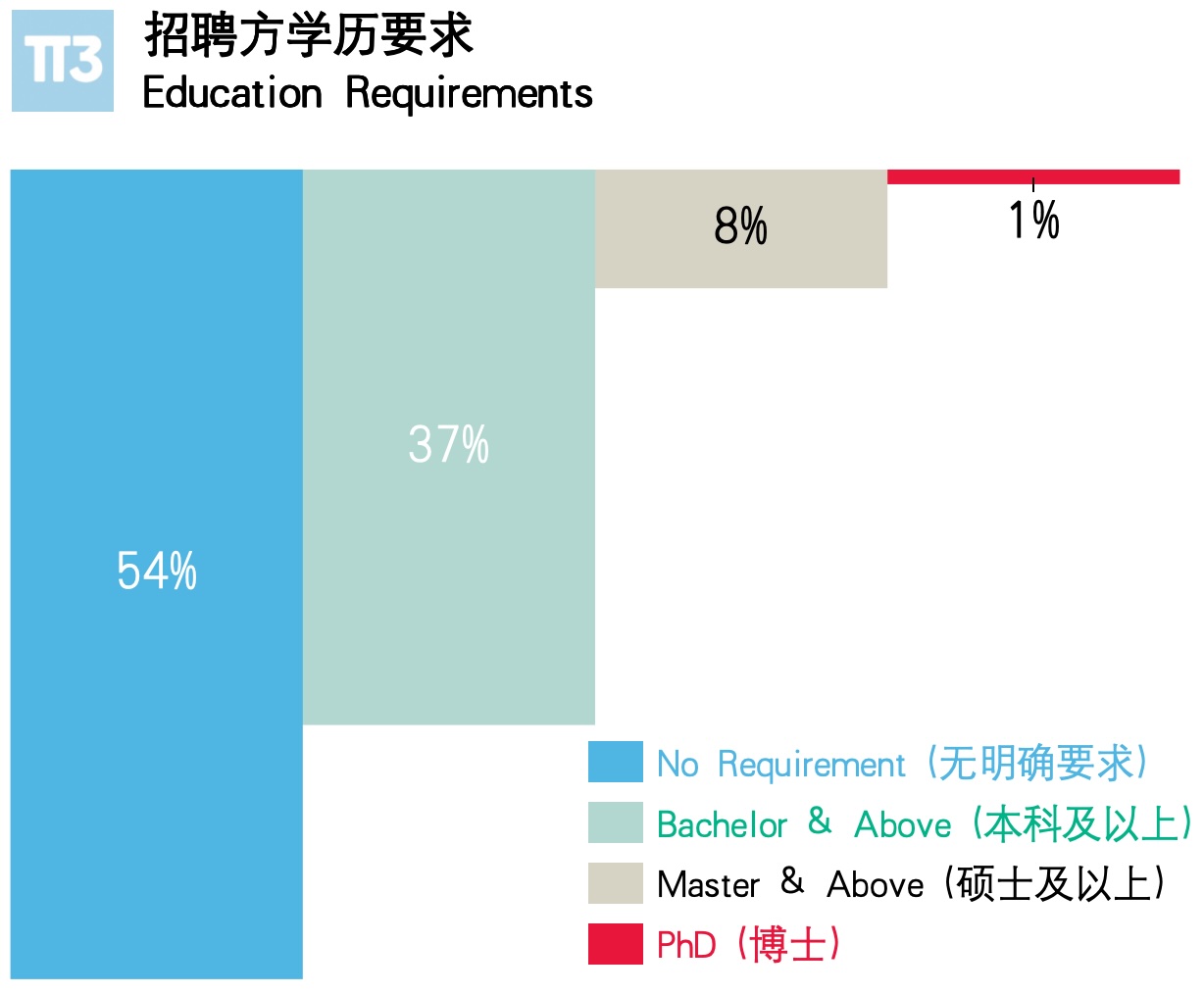
Among the new startup roles posted between Q4 2025 and February 1, 2026, alongside the roughly 46% that ask for a bachelor's degree or above, more than 3% spell out an explicit credential bar—preferring "985/211" universities or "top-XX QS" graduates. When a Web3 startup offers the equivalent of RMB 350,000–450,000 a year, that budget, in today's domestic job market, is enough to hire a top-school graduate with three-plus years of experience. This elite-style screening, falling into line with traditional industries, means Web3 hiring has moved on from its early "heroes asked no questions of their origins" phase into a far stricter filter.
1.3The Big-Tech Stamp Fails, and the Hidden Bar at Top CEXs
Compared with the bluntness of startup teams on credentials, the top-10 mainstream exchanges (CEXs) are more careful with the wording of their job descriptions—you'll rarely see explicit age or education limits—but the invisible industry bar has become even harder to clear. Looking at candidates' first-round pass rates, when choosing between a general-purpose technical expert from big tech with no industry experience and a candidate with two years in the field, most HR teams on our platform pick the latter without hesitation.
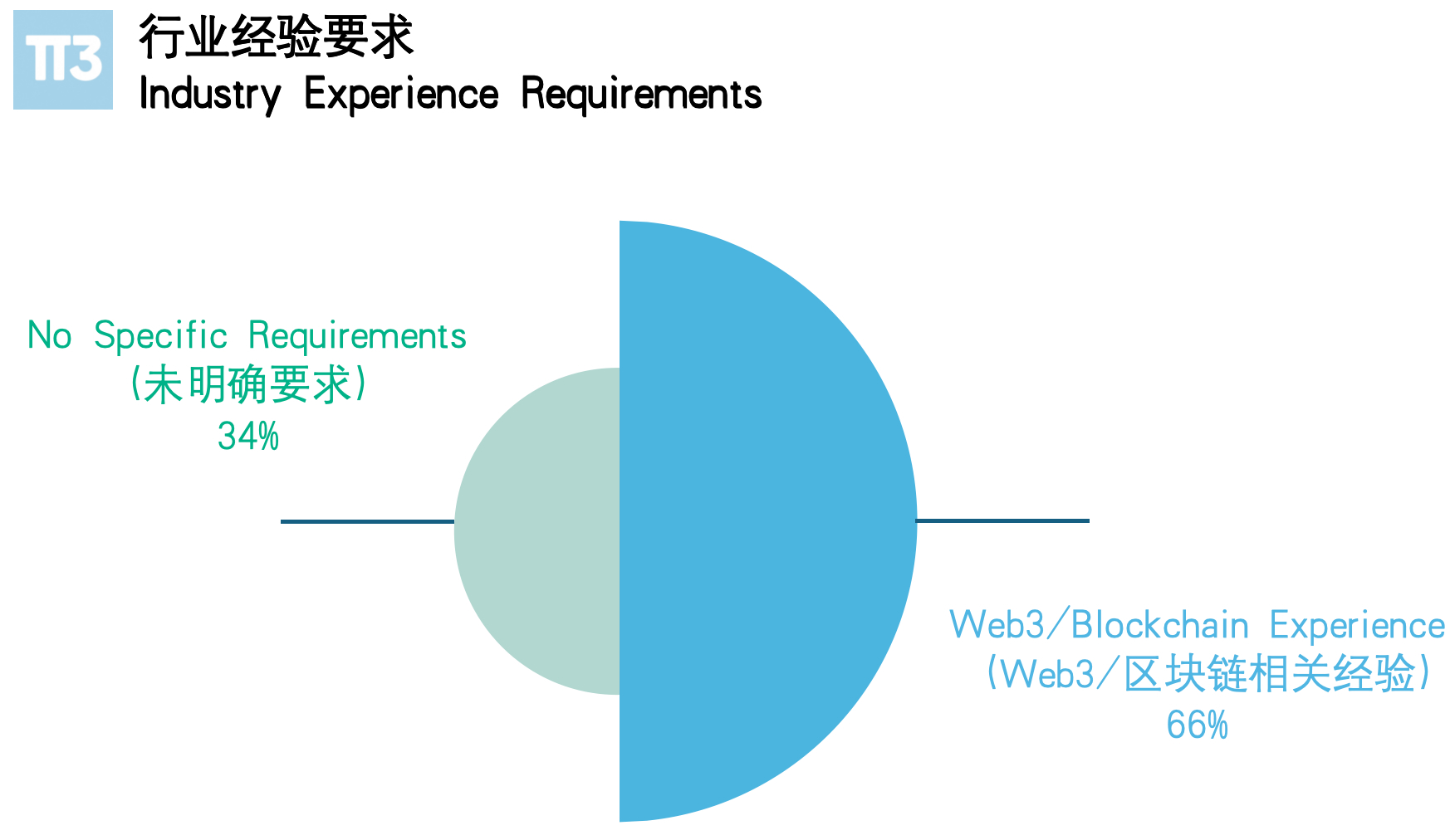
It's not that the people spilling out of big tech aren't technically strong—it's the nature of the CEX business. The core narrative of China's internet giants is built around traffic; the CEXs that anchor Chinese-language Web3 hiring sit closer to fintech and asset risk control. For a CEX, someone with trading experience who buys into blockchain logic and knows terms like "perpetual contracts" and "on-chain trading" cuts communication costs dramatically. So at this stage, industry know-how counts for far more than general skills. With nearly 70% of roles unfriendly to candidates with zero experience, the large pool of would-be entrants is left fighting over the remaining third.
1.4The Absurdity—and Practicality—of "Leveling Down to Level Up"
The soft bar of industry experience has bred a pragmatic job-hunting strategy. In our community discussions, veterans often hand newcomers this piece of "practical advice": to get the key into the inner circle, a software engineer years out of school will be steered toward a small DEX (decentralized exchange) or an early-stage project to work as an intern or "volunteer"—and the employers are happy to take on these seasoned candidates for that kind of "internship." Job seekers work for a few hundred dollars a month, or for nothing at all, just to add a stint of "on-chain" project experience to the résumé and make up for the big-tech halo failing at the industry wall. It's a plain form of labor exploitation, yet plenty of candidates in the market endorse it, betting it'll buy them a competitive edge—which, in its own way, says something about this industry's pull.
Chapter Two
Mismatch and the Employers
What the mainstream employers are actually looking for
A supply-and-demand mismatch isn't the scary part; practitioners' skewed read of the industry is scarier.
2.1The Biggest Employer You Can't Get Around: The CEX
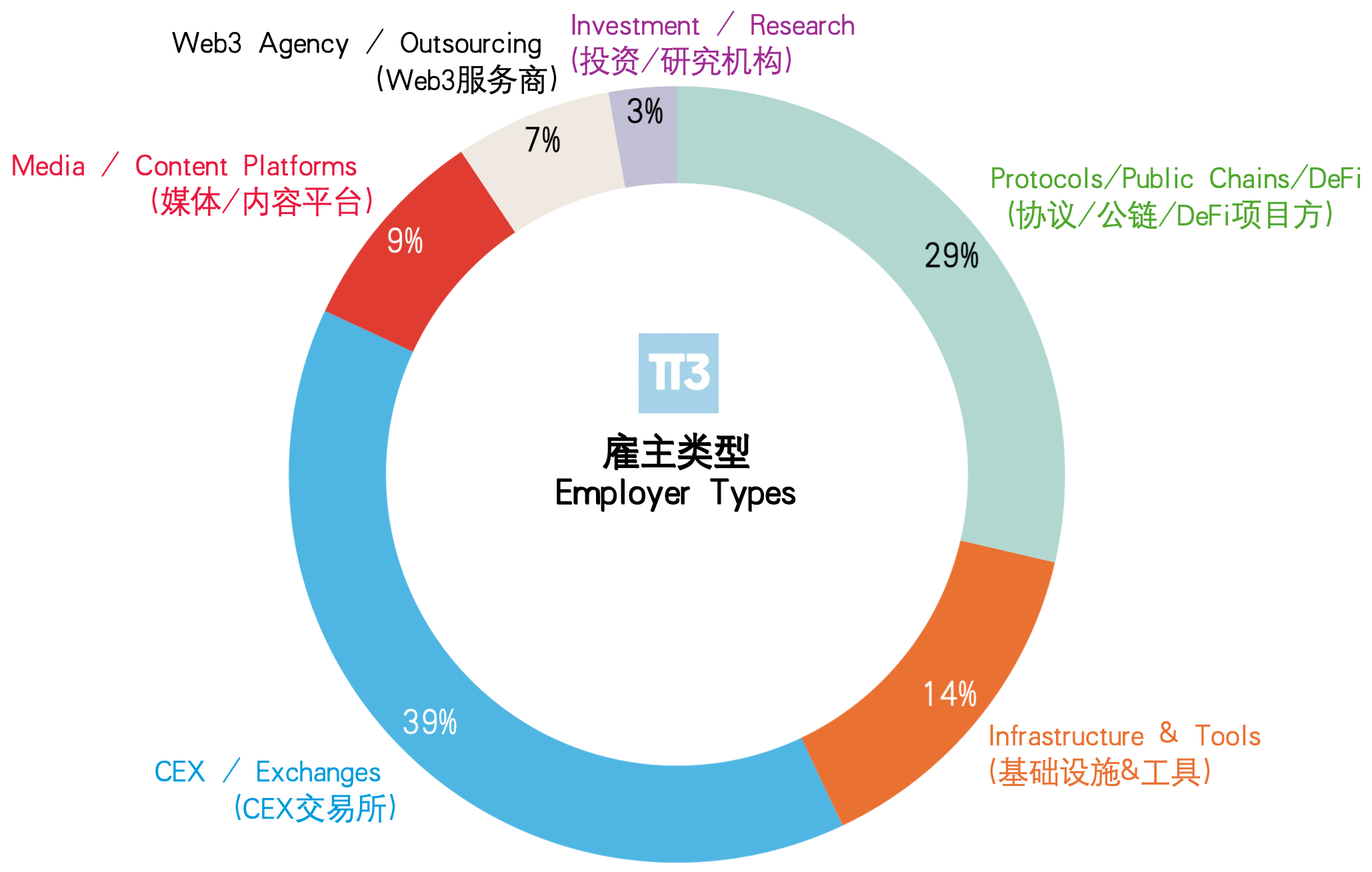
Although the decentralization narrative (DeFi/DAO) is the spiritual totem of the industry, in today's Chinese-language job market the CEXs (centralized exchanges) and their ecosystem companies are still, by a wide margin, the largest source of jobs—on our platform, at least. Compared with shakier project teams, CEXs have more public information, a more stable brand image, and more buzz on social media, which translates directly into a more transparent employer reputation—and trust is the most precious thing in this industry.
In this environment, many would-be candidates outside the industry tend to equate CEX with Web3. And while a CEX is where a lot of people first touch this field, a centralized organization can't fully represent the future of the decentralization story. Because a CEX is, at heart, financial infrastructure for trade matching and asset custody—earning on trading fees and on betting against the market—these employers get even tougher on risk control and headcount efficiency during periods of market turbulence. In a December 2025 interview at Binance Blockchain Week, Binance co-CEO Yi He named "insufficient talent density" as her organization's single biggest challenge right now. From our platform data and interviews, a top-5 CEX posting a new role can easily pull in more than a hundred résumés in a day across TG, its website, referrals, and other channels—yet its roles take an average of 25 days to close on our platform. Partly that's because our own daily active users still have plenty of room to grow; but it also shows, from another angle, that even the leading firms find it hard to land the employee they want. And "the employee they want" splits in two: on one side, the candidate has to fit the employer's ideal profile; on the other, the candidate has to actually hold some ideal and expectation for this industry—rather than chasing a quick buck off a skewed read of it.
2.2The Vanishing Middle: The "Demotion" from Manager to IC
We tracked several dozen senior candidates who job-hunted through TT3 and found a clear "title compression" pattern:
Among candidates whose résumés show non-Web3 team-management experience, it's not unusual for the new title, once they're on board, to become Senior Developer or Senior Analyst—managers dropping back into individual-contributor roles. Beyond the difficulty of converting experience as a newcomer to the field, a few other forces are likely at work:
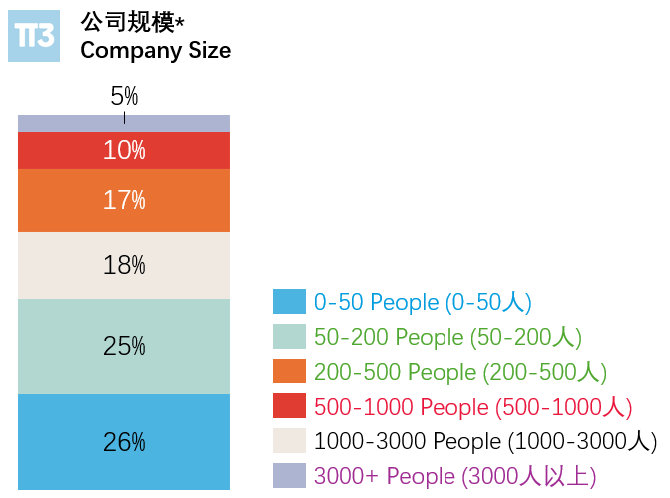
Scale limits. Even though social media tends to compare mainstream exchanges with first-tier internet companies like ByteDance and Tencent, apart from a handful of top-tier CEXs with thousands of employees, the vast majority of Web3 project teams have only a few hundred people—or a few dozen.
A flat org shape driven by a narrow business. Because mainstream CEXs still have limited business scenarios—various tokenized new lines are all still incubating and being explored—their relatively single, fee-based business model can't support a large middle-management layer the way an internet company's many BGs and BUs can.
Whether it's a token issuer, a crypto-card outfit, or an exchange of one kind or another, a company's incremental performance leans heavily on market conditions—or on the output of external KOLs and part-time BD—which leaves employers in a chronic state of revenue anxiety. That breeds an extremely twitchy approach to hiring: the moment results dip, they'll most likely move to shrink their people investment. This sense of drift makes a lot of people realize they're standing on a plank, and it pushes more practitioners to fire a shot and move on—some firing shots at several employers at once—leaving employees with little sense of belonging to, or identification with, the company. A sampling survey we built from our backend data shows the average tenure per Web3 job among current users is just 8.6 months. That a large share of practitioners are only after a quick buck has become as much an industry consensus as getting paid in stablecoins.
Chapter Three
Payday and Disenchantment
The cost lives where you can't see it
Only when "getting paid in stablecoins" goes from an industry consensus to common social knowledge do its risks and rewards start to be reckoned with seriously.
3.1From "Don't Get Scammed" to "What Protections Do I Get"
Anyone who followed our social account "Where's TT3" early on may remember a post we ran in Q3 2025 that stirred up a lot of discussion: "The Moment I Got a Web3 Offer, I Hesitated Instead." Back then the comments were full of questions and doubts—"is getting paid in stablecoins even reliable?", "will a company I've never visited just vanish?" Those worries represented the "high-risk perception" held by a segment of would-be practitioners.
Just two quarters later, stablecoin-compliance news arrived one piece after another—Hong Kong's Stablecoins Ordinance took effect on August 1, 2025, bringing fiat-pegged stablecoin issuance into a licensing framework, and such stories ran in mainstream media. Questions in the community about "payment safety" dropped sharply. The focus shifted to more concrete worries: routine labor concerns like social insurance and housing funds, and tax compliance. "Stablecoin-denominated pay" has gradually shed its stigma, but a few common-sense labor questions still trouble those waiting to enter the field, and they shape the decision to enter at all. As the compliance of business entities keeps improving, we hope it will also push employers toward more standardized hiring practices—and that protections for workers will fill in over time.
3.2Salary Distribution: The Visible Premium Converges
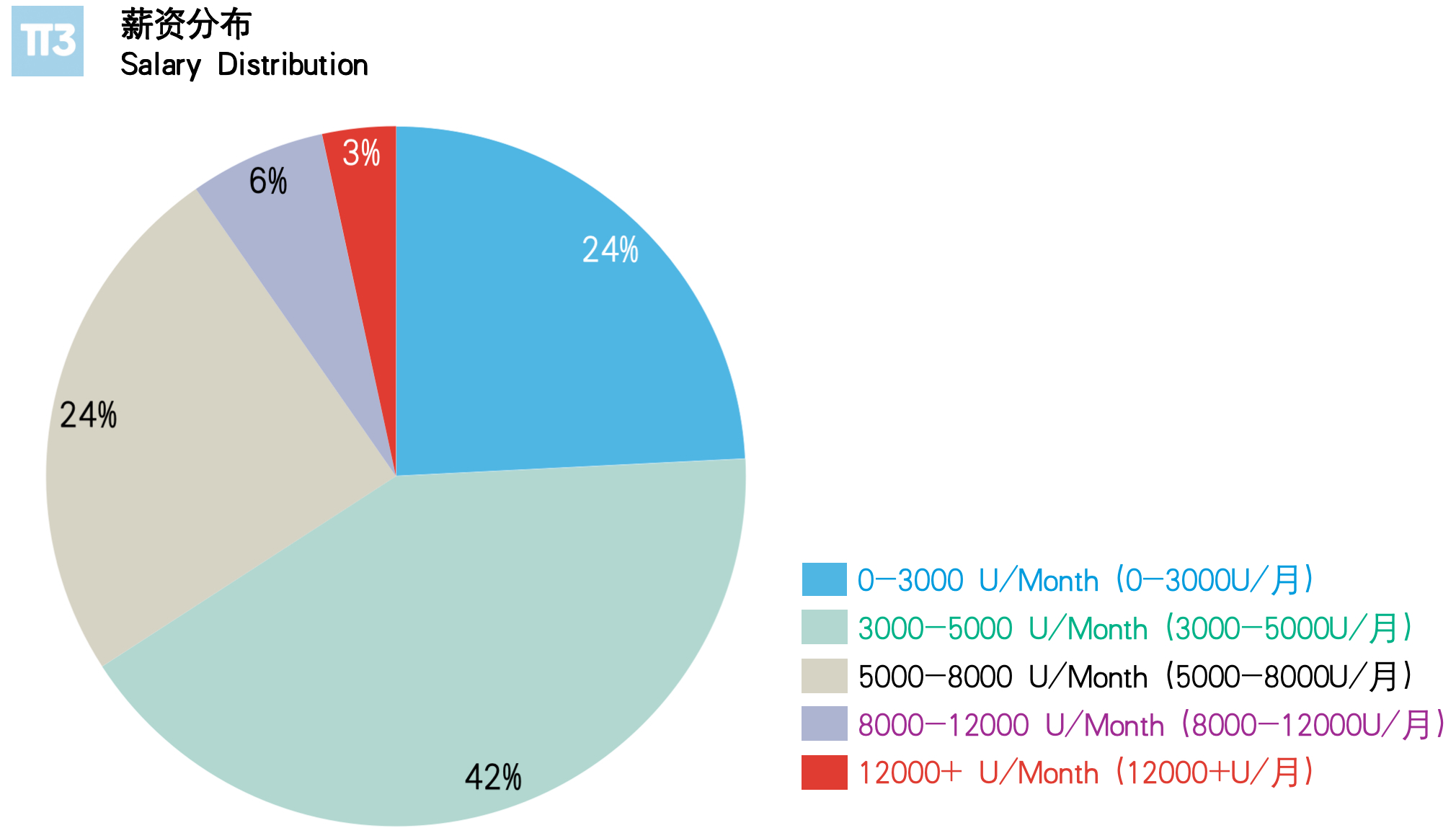
We see that mainstream pay on the TT3 platform sits at US$3,000–5,000—and once you factor in how much of it is "take-home," the industry still offers a decent return; for ordinary tech and operations roles, Web3's median salary overlaps to some degree with the traditional internet industry. The high-paying roles above US$8,000 cluster in a tiny number of core-protocol positions and "resource" roles that can bring a company meaningful growth. For most ordinary roles, the premium has already converged: more and more customer-support and operations jobs paying under US$3,000 a month keep going up, and Web3 is no longer an era where everyone lands a high salary. Job seekers are trading "no social insurance," "career instability," and other "policy risks" rarely seen in traditional industries—huge hidden costs—for the "geographic freedom" they're after.
But the comparison was never fair to begin with. People tend to line up the salaries of top-tier internet companies against some second- or third-string Web3 company's role, and—stacking their best horse against the other side's worst—reason their way to the conclusion that "this industry, or this company, or this role, isn't worth it." In reality, the top-quality roles in any industry are scarce and fiercely contested, and even between the leaders of different industries, the capacity to pay varies enormously by sector.
Chapter Four
Fortress Besieged
Identity anxiety and the "double migration"
As the compliance grid tightens, the middle ground left for digital nomads keeps shrinking.
4.1Starting with Singapore's "Visa Anxiety"
From Q4 2025 on, we clearly felt it in our conversations with candidates: talent based in Singapore began to focus, en masse, on the "visa" question. Because Singapore tightened licensing and pinned down permitted business scope in 2025, many organizations were forced into a fresh round of relocation. As the compliance red lines tightened, the talent who had once pinned their hopes on Web3 to solve their residency problem found themselves—under the pressure of work passes (EP/SP) with no realistic path to renewal—forced to look for a new way out. Over the past eight years, a great many companies have migrated nomadically and constantly; a company can settle down by securing a compliance license, but most of the practitioners who've gone abroad—until they've sorted out overseas residency—are herders who've lost contact with the tribe.
4.2Jobs on the Move, and Digital Nomads Heading Overseas
At the same time, compliance is tightening on the jobs side too. We've observed that a growing number of sensitive roles—especially those touching user data, HR, visas, payroll, and the movement of funds—carry "work authorization / nationality preference" constraints at a higher rate, and some go to the extreme of "Non-CN preferred" language, making a candidate's location one of the employer's main considerations.
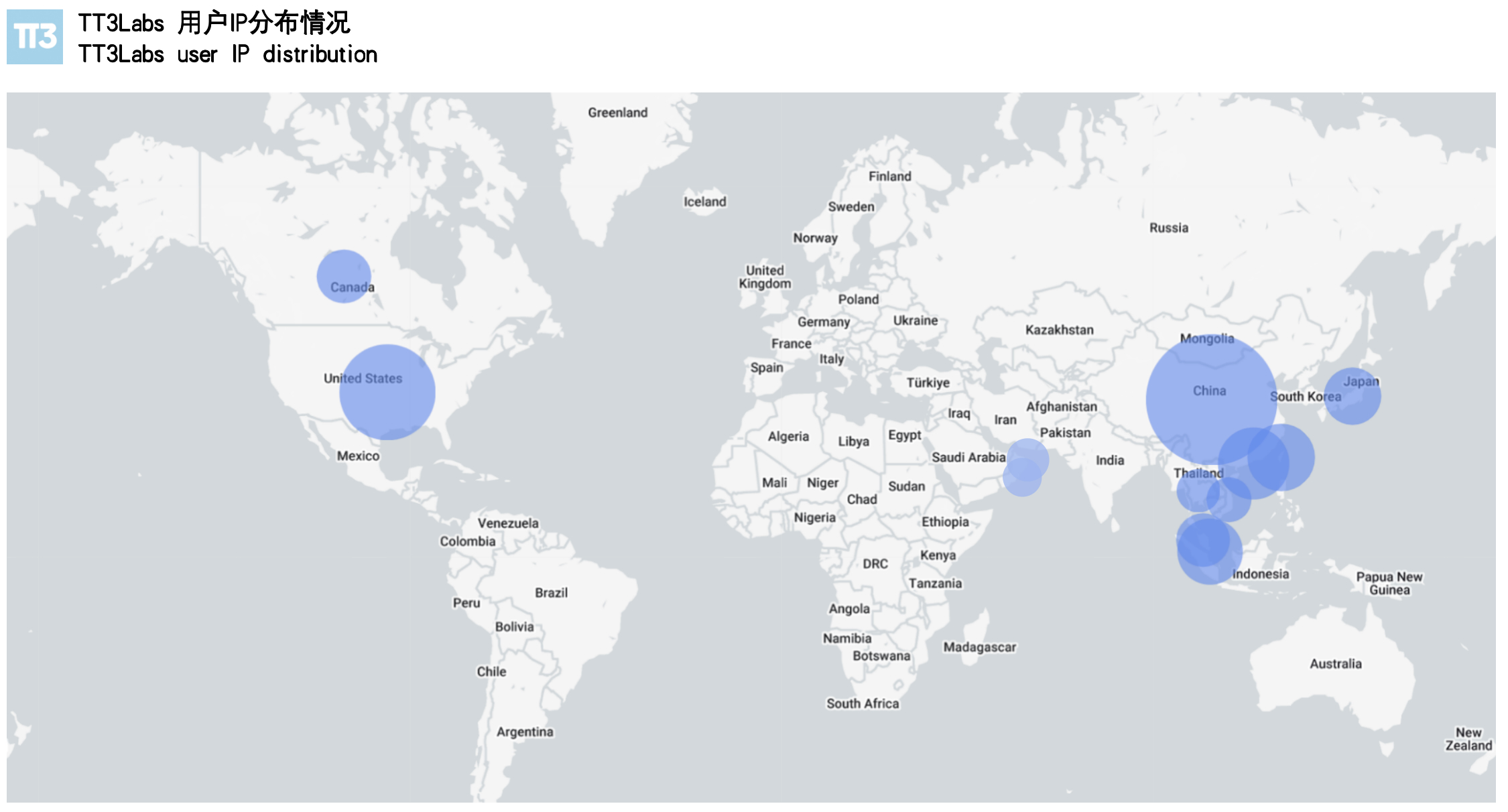
This state of affairs has set off a fresh wave of migration. TT3's user IP map shows IP activity in Southeast Asia climbing steadily. For one thing, Southeast Asia already has a deep pool of multilingual talent; for another, a great many Chinese-speaking professionals are running a geographic arbitrage—earning a global-level salary while living in a low-cost region, and enjoying a high quality of life as a result.
Meanwhile, some operations roles aimed at the Chinese-speaking market are shifting out of the hands of mainland-Chinese employees and toward ethnic-Chinese Malaysians and Thais, or foreign nationals fluent in Chinese. With the language advantage and none of the compliance baggage, they're becoming the new favorites of the Chinese-language Web3 job market.
In Closing
The Web3 job market in Q1 2026 is going through the growing pains of a return to common sense. The "overnight riches" story will always repeat itself on KOLs' X and Instagram feeds, but the rumors of ordinary practitioners striking it rich overnight are getting rarer. As the whole industry's hiring environment grows clearer and more transparent, it also means the leapfrog opportunities are thinning out.
As the line in our website footer goes—"Begin your new remote-career adventure"—every brand-new day is, to us, a new adventure. The stretch from the end of 2025 into the spring of 2026 has been a hard winter; the vision of riding into spring on horseback hasn't turned out as lovely as we'd imagined. Some get off, some get on. There's no lamp hidden in the candlestick chart to light the road ahead—your conviction is that lamp.
References
- TT3Labs operating data (Q4 2025 – Feb 1, 2026): anonymized platform operating data.
- Internet company financial reports
Tencent Financial Reports: tencent.com/en-us/investors/financial-reports.htmlAlibaba Group Reports: alibabagroup.com/en-US/ir-financial-report
- Public industry remarks (Binance co-founder Yi He): Dubai Blockchain Week 2025 transcript & Twitter Space records.
- Singapore compliance policy (MAS): Guidelines on Digital Payment Token Service.
- Stablecoin compliance developments (HKMA / MiCA): official notices from the relevant regulators.
- Community observation and sentiment: TT3Labs official community discussion records and Xiaohongshu keyword-trend analysis.
Originally published on TT3LABS.COM
The remote hiring platform for Web3 · AI · Fintech