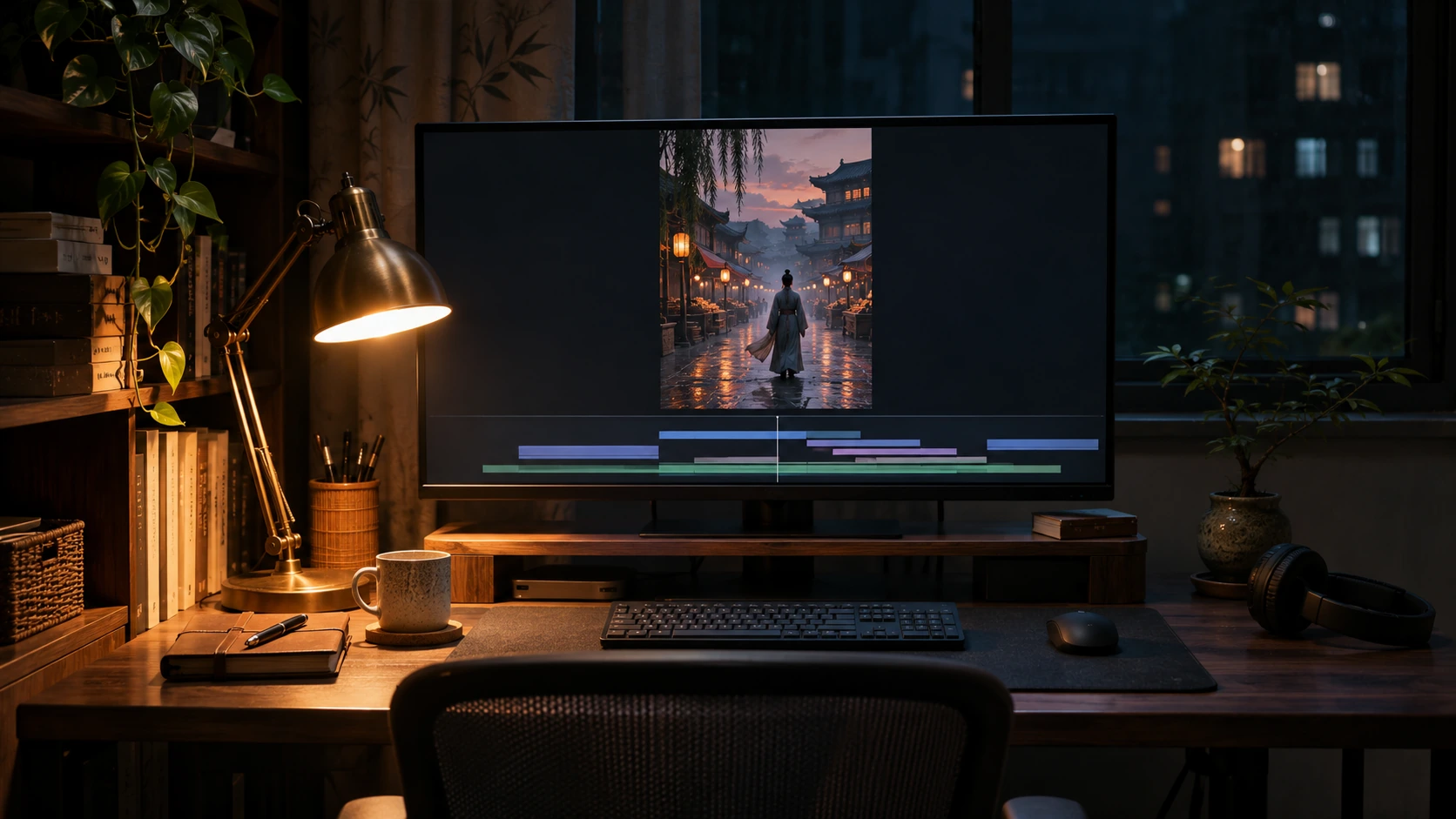
A wealth of information creates a poverty of attention.
Herbert A. Simon 1
Watch just one minute of every new short drama released in China in a day, and you’ll be watching for thirty hours.
China’s National Radio and Television Administration reported nearly 550,000 microdrama releases in the first ten months of 2026, or about 1,800 a day. In the same address, the regulator said that more than 94% of microdramas released that year were AI productions.2
On November 5, three of the people behind Chixie Ru Song, a period microdrama set in the Song dynasty, met in person at a Beijing high-speed rail station. By then, the show had been running for more than two months. Zhang Hansheng had picked the source novel, Li Chaohua assigned work and reviewed the episodes, and director He Xiushan led production on the first two. They had done all that over the phone, without once getting on a video call.3
All six members of the core team started out part-time and paid their own generation costs. The first two seasons went up on Hongguo and other platforms in August. When the team got to season three in September, its August revenue share came in and paid for more production. By early November, the show was ten seasons and roughly a thousand episodes in. Zhang put the cost of compute alone at about RMB 1 million.3
Hongguo had 236 million monthly users before its animation app
Watching dramas for free was already a habit on Hongguo when Chixie Ru Song arrived. Early experiments with AI production go back further. In March 2024, China Central Television aired Chinese Mythology, which used AI throughout production. By late August 2025, Douyin’s short-drama rights team was talking to studios that could deliver five or more comic dramas a month. It offered minimum guarantees and made a set of web novels available for adaptation. The question had become how many shows a crew could deliver each month.4
In September 2025, QuestMobile counted about 236 million monthly active users on the original Hongguo Short Drama app. Two months later, ByteDance repurposed a separate app, Xianning Free Short Drama, as a dedicated comic-drama service called Hongguo Free Comic Drama.4,5
The original Hongguo app carries both live-action and AI-made shows. Comic dramas typically look like animation or moving illustrations. Chixie Ru Song uses generated footage that looks like a live-action production. A studio’s hiring needs change with that choice. Experience in animation design comes in handy on one production, and cutting dialogue might matter more on the next.3,4
By September 2026, Hongguo Short Drama had 430 million monthly active users and its sister app had 78.83 million. Hema Theater and Huolong Comic Drama also had audiences of their own. On WeChat alone, the Green Bubble Short Drama mini app had roughly 156 million monthly active users. A small studio could make a new show knowing there were already places to put it in front of viewers.5
Monthly active users on selected short-drama apps
How free short dramas make money
Hongguo lets viewers watch for free and sells ad space to advertisers. Viewers can also buy an ad-free membership. In October, Hongguo said it spends most of its revenue on creator payouts, minimum guarantees for rights and support for selected shows. New episodes give viewers a reason to stay, and an audience that stays gives the platform more advertising to sell.6
Commission The client pays a fee
The platform or rights holder pays at agreed milestones or on acceptance. The fee covers the crew, model usage and any subcontractors. Extra work on a fixed-price contract can eat through the producer’s margin.7,8
Original Licensing or revenue share
The studio fronts the cost. For free comic dramas on Hongguo, the payout reflects eligible viewing time as well as the format and licensing terms.7
Suppose a hundred thousand viewers open each of two shows. On one, most people leave after the opening scene. On the other, they keep watching for several episodes. Even under the same terms, the two shows can earn very different payouts.7
China Literature reported more than RMB 430 million in combined revenue from short dramas and AI comic dramas in the first half of 2026. A filing from another listed company offers a closer look at the numbers. Its digital content business makes commissioned and original shows, and it earns a share of revenue from marketing work for partners. Here are the first-half figures for that business.8
One production company’s digital content business
- Recognized revenue
- 11.71m
- Cash collected
- 11.51m
- Cost of revenue
- 13.90m
- Gross loss
- 2.20m
The company collected most of that revenue. The work simply cost more to deliver than it brought in, leaving a gross loss of about RMB 2.2 million. The company attributed the result to high upfront investment and limited scale.8
More companies are entering the market. Qichacha’s business registry search found around 23,400 companies associated with AI short dramas as of July 30. Of those, 3,266 had registered in 2026. In early August, DataEye tracked more than 8,300 accounts publishing AI short dramas and comic dramas, including accounts run by individuals.9,12
Qixinbao identified at least nine publicly disclosed funding rounds in 2025, including investments in generative video tools. Wondershare disclosed a strategic investment in the tens of millions of yuan in a comic-drama studio and an agreement to develop creative tools together. China Literature, which owns web fiction rights, proposed a RMB 100 million equity support program. Novel rights can now be put to work in another format, and every production crew is a potential repeat customer for video software.9
What it costs to make an episode
Netflix co-CEO Ted Sarandos described an AI-assisted visual effects sequence in the Argentine series The Eternaut. “The cost of it just would not have been feasible for a show on that budget.” He estimated the team finished the sequence in about a tenth of the time a conventional VFX workflow would have taken. When the budget is tight, a crew can try a version of a scene it might once have cut from the script.10
At published Volcano Engine rates, a ten-second 720p shot generated with Seedance 2.0 at 24 frames per second, without a video input, uses roughly 216,000 tokens and costs about RMB 10 in model fees. If it takes three successful runs to find one usable shot, the bill is close to RMB 30. Generating three hours of footage at those settings and editing it down to an hour would cost around RMB 10,700 in video model fees. The writers, voice performers and editors are paid separately.11
One production company told Yicai it costs about RMB 500,000–800,000 to make one of its A-grade live-action shows, and about RMB 150,000–200,000 for an AI short drama. Those are figures from that company’s own slate. A fully generated show can save on location and cast costs, making it possible for a small team to try a few episodes. Once a series is underway, the character designs and locations need to hold up for the rest of the run. A late redesign can send a whole batch of footage back for another pass.3,11
Where is hiring demand?
Zhaopin reported that hiring demand for AI editors rose 179% year over year in June 2026, compared with about 7% for traditional editors. On August 10, DataEye counted more than 19,000 listings related to AI and comic dramas on three job platforms. That was a snapshot of visible listings, and a job could appear on more than one platform. Writers, script editors and post-production editors were among the roles most in demand. Guangzhou led by city, followed by Beijing and Hangzhou.12
Shot generation is becoming a job in its own right. Chinese studios often call the specialists chouka shi, a reference to drawing cards. They take a storyboard, generate several versions of a shot and pick the take that can go to post-production. Some studios hire separately for shot review. When several artists work on one episode, someone has to check whether the character still looks like herself from a new angle and whether the action matches across the cut. Both shot review and final quality control have appeared in full-time remote listings.11,12
About two-thirds of the shot-generation roles in DataEye’s sample advertised RMB 5,000–8,000 a month. The most common range for AI directors was RMB 10,000–15,000, accounting for around one-third of those listings. The director has to decide which looks and camera choices can carry through an entire season. Different people may make different episodes, and together they still need to feel like one show. For a small crew, it’s harder to find someone who can make good footage and see where the next round of work will break down.3,12
There are ways in with skills you already have. A web novelist can adapt two episodes and show which passages they cut because they slow down on screen. An animation artist can show how they would design a character to hold up in profile and across locations. An editor can show a whole dialogue scene, including the moments when they cut to the person listening and when they let the shot sit for another beat.
How the work differs across markets and business models
Sensor Tower estimates that short-drama apps drew more than 850 million downloads across the App Store and Google Play in the first quarter of 2026, with about US$750 million in in-app purchases. The figures cover live-action and AI shows. Southeast Asia, Latin America and India accounted for more than three-quarters of downloads. Kunlun Tech runs DramaWave as a paid product and FreeReels as a free service that makes money from advertising. Who watches, and when they might pay, shapes a production from the script onward.13
| Project | Revenue | What the team delivers |
|---|---|---|
| A free 3D comic-drama serial on Hongguo | The platform sells ads. The rights holder earns a share based in part on eligible viewing time. | Finished episodes, with characters and locations the next crew can use again. |
| A commissioned season that looks like live action | The client pays a production fee. Distribution revenue follows the terms of the release agreement. | Finished episodes, subtitles and audio tracks. Lip sync and eyelines have to hold up in close-ups. |
| An original English-language paid series for the US | Viewers pay to unlock episodes or buy a membership. The team tracks how many keep watching at the paywall. | English scripts and finished episodes, with natural dialogue and a story that carries viewers through their first paid episode. |
| A Chinese series dubbed into Indonesian for a free app | The app sells ads. The localization crew earns a service fee or an agreed revenue share. | Translated scripts, subtitles and dubbed audio that line up with the locked cut. The actor has the same few seconds to get the line out. |
Some short-drama editors cut ads from the episodes. They make a few versions of the opening and see which one brings in more installs and which of those viewers go on to pay. Someone who has made ads for a game or an ecommerce campaign may already have the right clips and test results for that pitch.12,13
At an editing interview, I’d ask how far along the first episode is. One crew may have all the shots ready to cut. Another may have a storyboard and expect its editor to make the missing footage. Both listings can say “AI short-drama editor.” For the first role, bring a dialogue scene you cut. For the second, show the storyboard and the finished scene together so the team can see what you took on.
A hiring manager can put the work directly in the posting.
We have a rough cut of episode one and can share the storyboard and character references. You’ll generate the remaining shots and hand them over to the editor.
Say when the shots are due and who signs off. For a remote contract, spell out how many rounds of revisions are included and who pays for compute. Then applicants know what to show you and how to price the work.
Who is paying for the next show?
DataEye counted 221,900 new original AI dramas and comic dramas on Douyin in the first half of the year. Of those, 1,055 passed a hundred million views, around 0.48%. Hongguo also adjusted its revenue-share rates for different comic-drama formats several times in 2026. Both viewing time and the terms on the payout statement can change between one show and the next.7,14
Who is paying for the next production?
A signed commission or receipts from a show that already earns enough to fund another season gives the crew a reason to keep its writers and editors on.
What to ask about three kinds of remote work
Full-time remote Ask about the slate
Shot review and final quality control have appeared in full-time remote listings. Ask when the next batch goes into production and how many shows are already confirmed.12
Project contract Agree on sign-off and payment
Set dates for acceptance and payment. If you deliver episode by episode, ask how many need to be accepted before you can invoice.
Revenue share Find out who fronts compute costs
Find out what you’ll pay upfront and whether you’ll see the platform’s payout statement before agreeing to a share.
If a crew gets a usable shot in two tries, it will revisit how many people it needs on generation alone. I’d put my money on people who already know one part of the work and can take on a bit of the next. An editor who can make the missing shots has more options when the footage comes in incomplete. A translator who can explain why a scene still makes little sense to a local audience may find work adapting scripts.
Zhang told Yicai that one member of the crew had to pick up her child during the day. In the early days of Chixie Ru Song, she sold barbecue with a friend in the evenings. She got home after closing the stall and sat down to make the show around midnight.3
After the show took off, a reporter asked the crew what had changed. Li Chaohua, who reviews the episodes, said he still spent his time working in front of a computer. Director He Xiushan said, “These days, everyone’s a lot quicker to top up their compute credits.”3
First published on TT3LABS.COM
A global platform for remote jobs in AI, Web3 and FinTech
Sources
- Simon on information and attention, pp. 40–41. Herbert A. Simon, Designing Organizations for an Information-Rich World
- Microdrama releases and share of AI dramas. The daily average is calculated from the reported total for the first ten months of 2026. National Radio and Television Administration, November 2026 address
- The Chixie Ru Song team, their work, computing costs and payouts. Interviews conducted in Chinese. Yicai interview · Xinhuanet interview · Guancha interview
- Early AI microdramas, comic dramas, minimum guarantees and Hongguo’s launch timeline. CCTV on Chinese Mythology · People’s Daily Overseas Edition on comic dramas · Blue Whale News on the November 2025 Hongguo update
- Monthly active users on Hongguo and other distribution channels. QuestMobile 2025–2026 annual trends report, September 2025 data · QuestMobile’s September 2026 rankings, reproduced by The Paper
- Advertising, optional ad-free membership and Hongguo’s spending on content. China Economic Weekly on advertising in free short dramas · Yicai on ad-free membership · Hongguo’s October 2026 statement
- Revenue sharing and production contracts. Reporting on free comic-drama payout rules · 21st Century Business Herald on commissioned and original productions
- Revenue, cost of revenue and cash collection. China Literature 2026 interim report · Listed company response to a 2026 interim-report inquiry, digital content section
- Company registrations, funding and investment. Qichacha company registry data · Qixinbao 2025 industry report summary · Wondershare investor relations disclosure · China Literature’s comic-drama program
- Netflix on visual effects time and cost for The Eternaut. Netflix Q2 2025 earnings interview · Transcript
- Model fees assume 1280 × 720, 24 fps, no video input and RMB 46 per million tokens. Volcano Engine model pricing · Yicai reporting on short-drama production costs
- Publishing accounts, hiring demand, pay ranges and remote roles. CCTV Finance interview with Zhaopin · DataEye survey of AI short-drama work · TT3Labs remote AI content jobs
- Worldwide downloads, in-app purchases, and ad-supported and paid formats. Sensor Tower, State of Short Drama Apps 2026 · Kunlun Tech 2026 interim report
- Releases and view counts for AI and comic dramas on Douyin. DataEye’s first-half 2026 figures